Invoice Finance for Transport Companies: How to Manage Slow Payment Freight Brokers
Invoice Finance for transport companies allows operators to access up to 85% of their unpaid freight invoices within 48 hours, helping to bridge the cash flow gaps caused by slow-paying freight suppliers and extended payment terms.
For a transport businesses dealing with 30, 60 or even 90-day credit terms, Invoice Finance can provide working capital without relying on property security.
If you run a transport or logistics business, you know that cash flow isn’t just about profit, it’s also often about timing. You can be moving freight across the country every day, with trucks full and invoices sent, yet still be finding your bank balance fall behind.
The reason is simple: slow-paying freight brokers. You’ve done the job, completed the delivery, and issued the invoice, but payment times sometimes stretch through to more than 60 days. Nevertheless, routine bills on fuel, wages, registration, maintenance costs, insurance, and other charges keep stacking week after week.
Coming up with money for expenses while waiting for payments is where many transport operators hit the wall. The good news is there’s a smarter way to keep wheels turning and cash flowing, and it doesn’t involve taking on more debt.
The freight broker cash flow trap
Freight brokers play an important role in connecting carriers with loads. But while they bring opportunity, they also bring delay. Their own clients, often the large shippers or retailers, can take months to pay, and that delay flows through to you.
Many operators resort to overdrafts or business loans just to bridge this cash flow gap, but those fixes are not necessarily the best cash flow solution when it comes to the bigger picture. Adding more debt and repayment obligations can send a business farther down the financial strain path.
That’s why more transport companies are turning to Invoice Finance to stay liquid and keep on top of their operations.
Why cash flow pressure is increasing in the transport industry
Cash flow pressure across Australia’s transport sector continues to intensify as operators face rising fuel costs, labour shortages and extended payment cycles from major freight brokers and customers.
ASIC’s latest insolvency statistics show a continued rise in external administration reports across Australia’s transport, postal and warehousing sector, with reported insolvencies increasing from 196 in FY2021–22 to 734 in FY2024–25Long payment cycles remain a major issue across freight and logistics. Many transport operators wait 30–90 days to receive payment despite needing to cover fuel, wages, maintenance and subcontractor costs upfront.
How Invoice Finance keeps transport businesses moving
Invoice Finance turns your unpaid invoices into immediate working capital. Instead of waiting for freight brokers to pay, you can access up to 85% of the invoice value as soon as it’s issued.
Here’s how it works:
- You complete a delivery and issue an invoice to the broker.
- The finance provider advances most of that amount straight away.
- When the broker pays the invoice, the remaining balance is released to you, minus a small fee.
The result? Your cash flow starts running on your schedule, not others.
This is particularly a powerful tool for transport operators simply because their costs are frequent and predictable. Fuel, wages, and repairs don’t wait, they are almost always urgent or immediate, and with Invoice Finance in your tool kit, you don’t have to wait either.
Invoice Finance vs Traditional Funding Options for Transport Operators
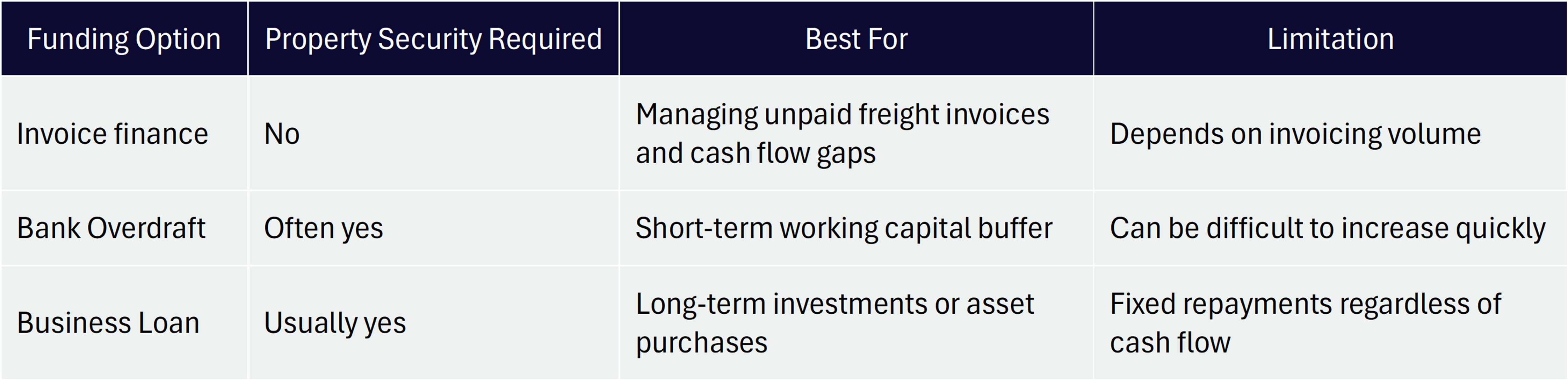
The real-world benefits
- Smooth, predictable cash flow
Invoice Finance bridges the gap between invoicing and payment. No more juggling bills or delaying maintenance waiting for money to land in your account. - No debt or repayments
Unlike loans, Invoice Finance isn’t borrowed money. There are no fixed repayments or compounding interest, it provides access to funds you’ve already earned. - Scales with your work
When business picks up and you’re issuing more invoices, your available funding grows automatically. When things quieten, it scales back down. - No property security required
Your receivables are the collateral, so you don’t need to put your home on the line. This can be a massive relief for small fleet operators and subcontractors.
The hidden costs of waiting
Many transport operators underestimate the cost of having to wait to get paid. The strain doesn’t just affect the cash flow but also ripples through the entire business.
- Maintenance gets delayed, increasing long-term costs.
- Drivers lose confidence when wages or reimbursements lag.
- Fuel suppliers tighten credit, adding more pressure.
- Growth opportunities are missed because cash is locked away in invoices.
By using Invoice Finance, you turn those locked-up funds into active working capital. That means you can pay suppliers on time, take on extra delivery rounds, and even negotiate better rates with suppliers by being a reliable payer.
A smarter alternative to loans and overdrafts
Business loans and overdrafts can be useful tools, but they’re blunt instruments for cash flow requirements in a transport environment. They create long term obligations in a world where revenue timing is anything but fixed.
Invoice Finance, by contrast, works in harmony with the natural flow of the industry. Every completed delivery becomes both income and liquidity. The funding scales with your workload and ends when the invoice is paid, no ongoing debt, no hidden traps.
It’s the kind of flexibility transport businesses have always needed, and can finally access.
Why transport businesses choose Earlypay
Transport businesses often need to cover fuel, wages, maintenance and subcontractor costs long before freight invoices are paid. Access to reliable working capital can make a significant operational difference.
With Earlypay, transport operators can benefit from:
- Access up to 85% of invoice value upfront
- No residential property security required in many cases
- Integration with leading accounting platforms like Xero and MYOB.
- Facilities that scale alongside invoice volume
- Experience supporting Australian transport and logistics businesses
Rather than relying on traditional lending structures, Invoice Finance provides funding directly linked to outstanding invoices and business activity.
FAQs
Can I use Invoice Finance if my freight broker pays in 90 days?
Yes. Invoice Finance is commonly used by transport operators dealing with extended payment terms from freight brokers, major retailers and large customers. Funds are advanced against approved invoices before the customer pays.
Do I need property as security for Invoice Finance?
In many cases, no. Invoice Finance is typically secured against outstanding invoices rather than residential or commercial property.
How quickly can transport businesses access funds?
Depending on the provider and onboarding requirements, transport businesses may access funds within 48 hours after the application is approved. Once your facility is set up, you can access cash as soon as you send an invoice to your customer.
Is invoice finance suitable for subcontractors and owner-drivers?
It can be suitable for owner-drivers, subcontractors and growing transport businesses that experience delays between completing freight jobs and receiving payment.
What invoices can be funded?
Most providers fund B2B invoices issued to approved commercial customers, including freight brokers, logistics companies and corporate clients.