Christmas shutdown cash flow: Planning for employee leave, payroll and January
Published
For many Australian businesses, the Christmas shutdown isn't necessarily the hardest part of the holiday season. It's managing the financial commitments that fall due before, during and immediately after it.
Projects wrap up, customers close for the break, and employees head off on annual leave. Yet wages, superannuation and other operating expenses still need to be paid, often before customer payments start coming through again.
This can be particularly relevant for businesses in construction, transport, manufacturing and labour hire, where payroll and operating expenses can continue even when business activity slows.
And the challenge isn't always about how much money a business is making. Sometimes, it's simply when that money becomes available.
Here's what Australian businesses should consider when planning their cash flow around the Christmas shutdown.
Understanding the cash flow impact of a Christmas shutdown
A business might close for two weeks over Christmas, but the financial impact can stretch well into January.
Take a manufacturing business that finishes its final project for the year in December. Employees may be taking annual leave, suppliers still need to be paid, and materials may need to be purchased before work resumes.
Meanwhile, some customers won't pay outstanding invoices until their accounts teams return in January.
The business may have completed the work and issued the invoices. The money just hasn't arrived yet.
That difference between when expenses fall due and when customer payments come in is what can create a temporary cash flow gap.
For businesses with employees, understanding the timing of payroll and leave payments is a good place to start.
Plan employee leave and shutdown arrangements early
Christmas is a popular time for employees to take annual leave. For businesses that temporarily close, however, there are a few additional things to consider.
Under Australia's workplace laws, an employer's ability to direct employees to take annual leave during a shutdown depends on the applicable modern award, enterprise agreement or other employment arrangements.
Many awards require written notice of a shutdown, often at least 28 days in advance. Requirements vary, though, so businesses should check the conditions that apply to their employees before confirming arrangements.
It's also worth reviewing individual leave balances. Learn more about the dangers of unused leave.
Some employees might have sufficient accrued leave to cover the entire shutdown. Others may not. Depending on their applicable award or agreement, options such as annual leave in advance or unpaid leave may be available by agreement.
These arrangements shouldn't be left until the last payroll run in December.
Factor in leave loading and public holidays
Annual leave is generally paid at an employee's base rate of pay, although awards and enterprise agreements may provide additional entitlements, including annual leave loading.
Public holidays also need to be accounted for separately.
For the 2026–27 Christmas period, Christmas Day falls on Friday 25 December and New Year's Day falls on Friday 1 January. Additional public holidays and arrangements vary between states and territories.
Where a public holiday falls during an employee's annual leave, the day generally isn't deducted from their annual leave balance. Eligible employees may also be entitled to payment for the public holiday.
This matters when calculating leave balances and payroll costs.
Annual leave isn't automatically an additional expense on top of normal wages. In many cases, it's wages paid while an employee is away. The cash flow pressure comes from when those payments must be made, any applicable leave loading and how these costs line up with incoming cash.
For a business with a sizeable workforce, getting those dates and amounts right is important.
Remember Payday Super when planning Christmas payroll
There is another consideration for businesses heading into Christmas 2026: Payday Super.
From 1 July 2026, employers generally need to pay superannuation at the same time as employee wages, rather than making quarterly contributions.
Under the new arrangements, superannuation guarantee contributions are generally calculated at 12% of qualifying earnings and must reach employees' super funds within seven business days of payday, subject to certain exceptions.
This makes the timing of superannuation payments a more immediate part of payroll cash flow planning.
For businesses running weekly or fortnightly payroll, contributions may need to be processed during the Christmas and New Year period.
Public holidays, payroll processing schedules and potential payment delays should all be taken into account.
Before the shutdown, businesses should check their payroll dates, superannuation payment arrangements and processing timeframes.
After all, a closed office doesn't mean payment obligations stop.
Businesses can refer to the Australian Taxation Office's Payday Super guidance for the latest requirements.
Match shutdown expenses against expected customer payments
Once employee leave and payroll commitments are clear, the next step is to look at when customer payments are actually expected.
This is where the Christmas shutdown can create an issue that isn't always obvious from an ordinary monthly cash flow report.
An invoice might be due on 5 January. But if the customer's accounts payable team doesn't return until 11 January, the payment may arrive later than expected.
And if the invoice still requires approval, it could take longer.
Rather than relying only on invoice due dates, businesses should consider the payment processing schedules of their major customers.
The practical question is straightforward: Will enough cash be available on the dates the business needs to make payments?
A simple weekly view covering the final weeks of December and the first few weeks of January can help answer that.
For businesses with large payroll commitments, even a relatively short delay in receiving customer payments can affect the amount of working capital available.
What could a Christmas shutdown cash flow gap look like?
Consider a hypothetical Australian business preparing for a two-week Christmas shutdown.
It has cash available and expects some customer payments before mid-January. It also has several operating expenses falling due during that period.
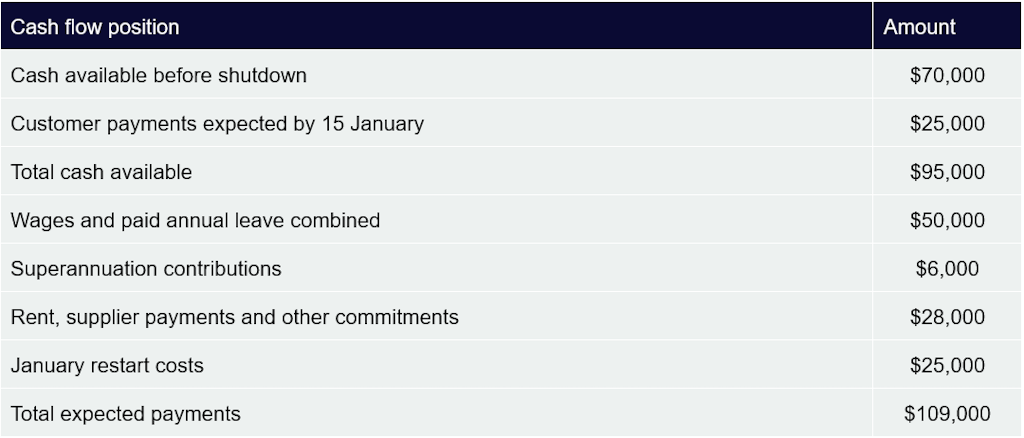
Note: Illustrative example only. Actual costs, superannuation liabilities and payment dates will vary by business.
The business might have another $60,000 in outstanding customer invoices expected to be paid later in January.
On paper, those invoices represent money owed to the business.
But they don't necessarily help cover payments due before 15 January.
This is why understanding the timing of cash flow matters just as much as knowing the total value of outstanding invoices.
And it's something worth assessing before operations wind down for Christmas.
Don't overlook the cost of restarting in January
For some businesses, the first few weeks back can require almost as much planning as the shutdown itself.
A transport operator may need to cover fuel and driver wages as deliveries resume. A manufacturer might need to purchase materials before production restarts. A labour hire business could be paying workers for new assignments while waiting for clients to settle earlier invoices.
These are normal operating expenses. The challenge is that they can fall due before customer payments return to their usual cycle.
Businesses should therefore consider what cash will be required to restart operations, not just what is needed to get through December.
That might include the first payroll run of the year, essential supplier payments, materials, equipment costs or additional workforce requirements.
The goal isn't to eliminate every cash flow gap. It's to understand the commitments ahead of time and have a plan to meet them.
Where working capital finance may help
Even with the right planning in place, businesses can experience periods where incoming and outgoing payments don't align.
When funds are tied up in unpaid customer invoices, accessing additional working capital may help maintain day-to-day operations without having to wait for those invoices to be paid.
Invoice Finance is one option worth considering.
It allows eligible businesses to access funding against outstanding invoices for completed work, helping bridge the time between issuing an invoice and receiving customer payment.
For businesses managing Christmas payroll and January operating expenses, that flexibility may be useful.
Earlypay also offers Invoice Finance for payroll, designed for labour hire and contractor management businesses that need to pay workers before clients settle their invoices.
The appropriate funding solution will depend on the business, its invoices and its requirements, including eligibility and facility terms.
A few questions to settle before Christmas
Before the business closes, it's worth making sure the key financial dates are clear.
- Have employee leave arrangements been confirmed, including any necessary shutdown notices and agreements?
- Have payroll, leave loading, public holiday entitlements and superannuation payments been accounted for?
- Do you know when your major customers will process their final December payments?
- Are the costs of restarting operations in January included in your cash flow plan?
- Is there enough available working capital to cover commitments if customer payments arrive later than expected?
These don't have to be complicated discussions. But having them before the shutdown can help reduce uncertainty when the new year begins.
Looking for more flexibility with your business cash flow?
Earlypay helps Australian businesses access working capital tied up in unpaid invoices through tailored Invoice Finance solutions.
Explore Earlypay's Invoice Finance solutions or speak with our team about your business needs.